You Can Measure AI in Learning Now. Here’s How
By Chad Udell
For years, learning leaders have operated on faith.
You deploy training. People complete it. A score gets logged. And somewhere between the completion certificate and the quarterly business review, you cross your fingers and hope it worked.
Most AI tools in learning right now are black boxes. The conversation happens, the session ends, and nothing gets captured. You have no idea what your people asked, what they struggled with, what they got wrong three times before they got it right, or whether any of it transferred to the job.
The good news is this problem is solvable. And the solution already exists. It’s just that most vendors deploying AI in learning either don’t know about it or haven’t bothered to implement it.
The Measurement Gap Nobody Is Talking About
Think about what happens when a frontline worker pulls out their phone and asks an AI chatbot “what’s our protocol for handling a customer complaint?” They get an answer. Maybe a good one. But did that count as learning? Did it change behavior? Did it lead to a better outcome on the floor?
Without infrastructure designed to capture that interaction, you will never know.
Most AI tools weren’t built with learning measurement in mind. They were built for productivity, or customer service, or general-purpose assistance, and learning just got bolted on as a use case later. The result is AI interactions that generate zero actionable data for the people responsible for workforce performance.
This is a real problem. Not a hypothetical one. And it’s happening right now at a lot of organizations that are excited about AI but haven’t thought through what “measurement” actually means in this context.
What Learning Standards Were Built For
This is where xAPI comes in, and if you haven’t heard of it, that’s okay. It doesn’t get a lot of press outside of L&D circles, but it’s been quietly doing important work for over a decade.
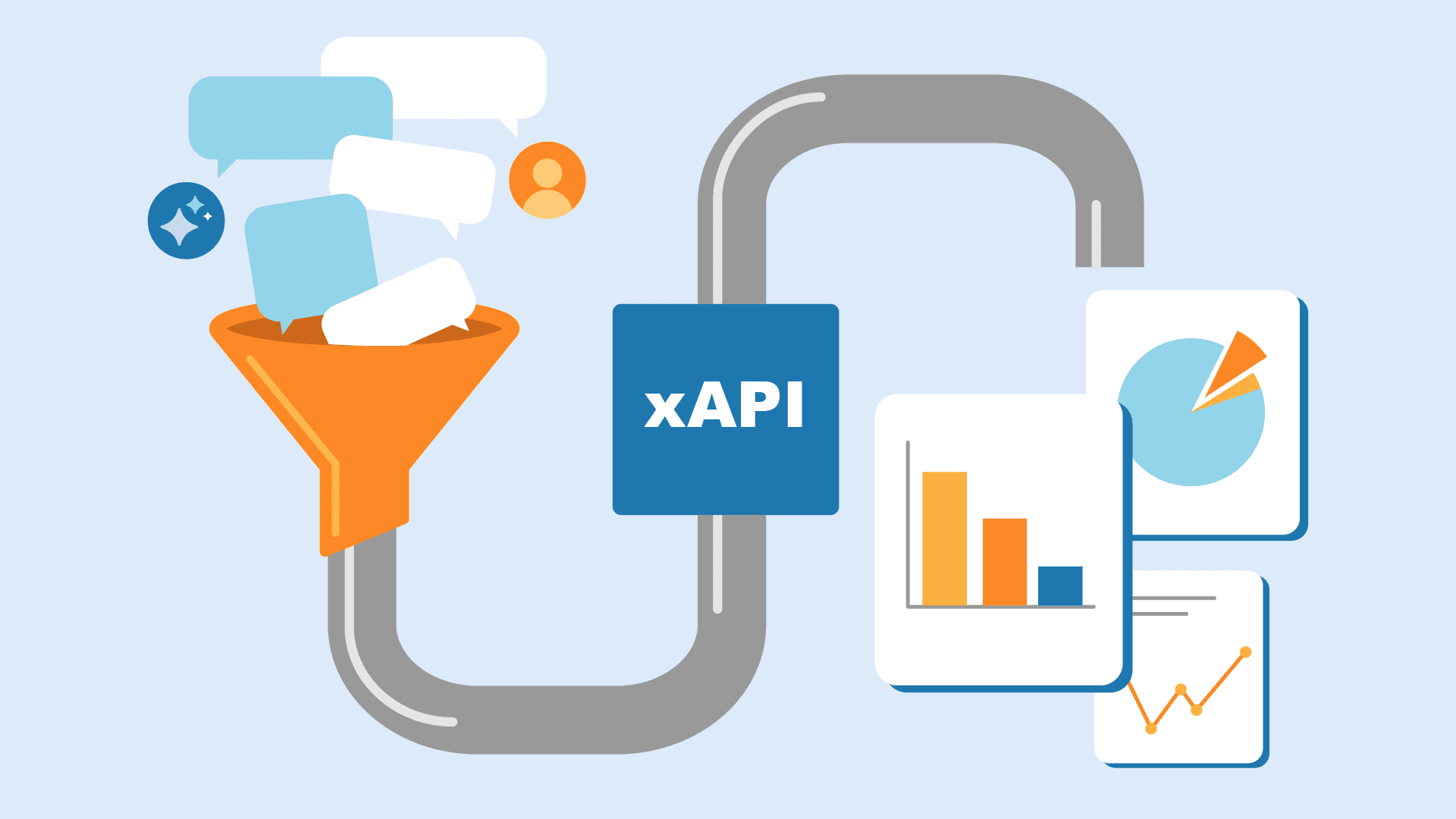
xAPI (also called the Experience API, or Tin Can API if you’ve been around long enough) was designed specifically to capture learning experiences that happen outside a traditional course. Things like on-the-job practice, simulations, mobile performance support, and yes, conversations with AI.
The core concept is straightforward. Every meaningful learning interaction can be described as a statement that follows the pattern: Actor, Verb, Object. A learner asked a question. A learner reviewed a policy. A learner completed a scenario. A learner got something wrong and tried again.
Those statements get stored in a Learning Record Store, or LRS, which is a purpose-built database for receiving, organizing, and surfacing learning data from across your entire ecosystem, regardless of where the learning happened.
xAPI was designed for a world where learning doesn’t live inside a single platform. As it turns out, that’s exactly the world we live in now.
Why This Matters for AI Specifically
AI conversations are learning events. They deserve to be treated like learning events.
When someone asks the AI a question and gets an answer, that’s a performance support interaction worth recording. When they ask the same question three different ways before they seem satisfied, that’s a signal about comprehension worth capturing. When a whole team is consistently asking about the same process, that’s a knowledge gap worth acting on.
Without xAPI infrastructure underneath your AI tool, all of that signal disappears. You’re left with usage statistics at best. Number of sessions. Average response time. That kind of thing. Useful for IT, not useful for L&D or operations.
With xAPI in place, every conversation becomes a data point in a larger picture of workforce knowledge and performance. And over time, that picture gets genuinely useful. You can start to see which topics spike during onboarding, which questions cluster before a product launch, which support requests indicate a training problem upstream rather than a knowledge problem in the moment.
Closing the Loop with Business Outcomes
Here’s where this becomes interesting to operations leaders, not just L&D.
Learning data connected to business outcomes is powerful. Learning data on its own is interesting. But when you can put workforce knowledge alongside operational KPIs, something changes.
When you know a cluster of employees was repeatedly asking questions about a specific process, and you can put that alongside error rates, customer complaint logs, or audit results, you’ve done something that almost no learning organization has historically been able to do. You’ve connected the learning investment directly to operational performance.
xAPI makes that possible because it creates a common language for learning events that can be joined with your other business data. Your LRS becomes a source of truth for workforce knowledge, not just a report card for training completions.
For CLOs making the case for investment at the executive level, that’s a fundamentally different conversation. Not “we trained 200 people this quarter.” Instead, “here’s where the knowledge gaps were, here’s how we closed them, and here’s the operational metric that moved as a result.”
That’s the kind of evidence that gets budgets approved and programs expanded.
What to Look for in an AI Learning Tool
If you’re evaluating AI tools for learning right now, here are the questions worth asking:
Does the tool generate xAPI statements for AI interactions? Not just course completions, but actual conversation events?
Where does that data go? Does the vendor provide an LRS, or does the data flow into your existing one?
Can you segment the data? Role, location, team, content topic? Aggregate data tells you very little. Segmented data tells you where to act.
Are sources cited transparently? If the AI is pulling from your content library, you should know which content it’s using and how often. That data is useful for content strategy, not just compliance.
These aren’t trick questions. They’re basic infrastructure questions. And if a vendor can’t answer them clearly, that’s telling.
How SparkLearn Approaches This
SparkLearn AI Chat was built on xAPI from the start, not retrofitted onto it later. Every interaction generates structured learning data: what was asked, which content was surfaced, how the conversation unfolded, and how that maps to your content permissions by group and role.
We’ve spent years helping organizations in utilities, field services, hospitality, and healthcare track learning the right way. Not because measurement is trendy, but because it’s the only honest way to know if learning is actually working.
The new AI Chat feature is the latest expression of that same commitment. Conversational AI with the transparency, governance, and measurement infrastructure that serious learning organizations need underneath it.
If you’re deploying AI in your workforce and you can’t answer the question “is it working?”, you should probably find out why before you go any further.
See It for Yourself
SparkLearn AI Chat is available now. If you want to see how AI-powered learning with real xAPI measurement works in a live product, not a slide deck, we’d be glad to walk you through it.
Schedule a demo at sparklearn.com
SparkLearn is a mobile-first learning platform built for the modern workforce.


